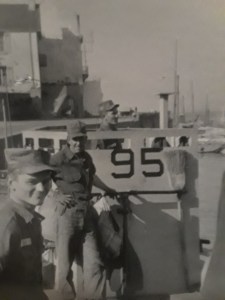
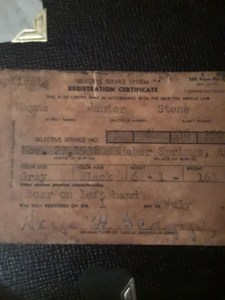
My dad was in the Army in the 1950’s. He served when we still had a draft, and young men were regularly called upon to enter the service. He was a skinny, country boy from Arkansas who got to see a good bit of the world while in the Army. He was a coxswain (boat driver) and drove landing craft for the 81st Transportation Company. That used to confuse me, until I researched the fact that the U.S. Army used to operate their own landing craft. Nowadays, that’s left to the Marines and Navy. He also operated PT boats out of Portugal, as part of a search and rescue oriented unit. He drove boats on the Rhine River Patrol, while stationed in Germany. This was during the early Cold War days, Dear Reader, when a shooting war with the USSR (Russia) was a very real possibility.
He managed to see the coast of Lebanon in 1958, when President Eisenhower sent troops to that country to help bring about a cease fire to their civil war. They landed some 8,509 Army troops from the 1st Airborne Battle Group and the 24th Infantry Division and 5,670 Marines from the 2nd Provisional Marine Force. The landings weren’t opposed, or fired upon. The Operation, code named Blue Bat, utilized some 70 ships and over 14,000 naval personnel. It included 3 aircraft carriers, two cruisers, and two destroyers squadrons. The plan was to occupy and secure the Beirut International Airport, a few miles south of the city, then secure the port of Beirut and approaches to the city. All of this was to support the pro-Western Lebanese governent of President Camille Chamoun against internal opposition and threats from Syria and Egypt. The operation lasted about three months, then the troops were pulled out. One U.S. soldier had been killed by rebels, and one wounded. Two Marines were also killed by friendly fire. This was America’s first armed intervention into the Middle East. You can read more about it at: http://www.photorientalist.org/enhibitions/operation-blue-bat
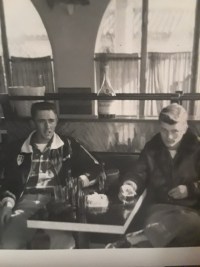
I asked my Dad once if he’d ever been shot at, while he was in the Army. He told me a story about when his unit helped land the troops in Lebanon. There were no problems landing the U.S. troops. His unit operated landing craft, and stayed on board the LST’s in the Mediterranean Sea. The three month deployment bored the crap out of he and his buddies. So, when they got the opportunity to deliver supplies ashore, they decided to have a look around. The neighborhood near the beach head seemed quiet. Lebanon had long been considered a tourist magnet for the Middle East, and the beach front was scenic and full of shops and cafes. There was no fighting to be heard, so they strolled down the street and found a cafe. As they enjoyed a beer and tried the local cuisine, a car full of rebels did a 50’s version drive-by and sprayed the plate glass windows of the cafe with submachine gun rounds. Specialist Stone and his fellow soldiers dove for cover and flipped over a wooden table for cover. Luckily, no one was hurt. They all decided to return to the safety of the ship. Boredom didn’t seem quite so bad, compared to being shot at. I’m glad. If not for the crappy shooting of the rebels, I may have never been born.
He also played a lot of baseball. He played for an All-Services European Theater league that played all over Europe. He was a catcher, mainly, but fielded some, too. He even pitched a few games. They won their version of the “World Series” of the Army when he was on the team. Not too shabby. He said it was covered by Stars and Stripes, but the publication is only available on microfilm from that era. I’m still working on finding an article on it. He also lost most of his personal baggage on the return trip to the States, including a lot of his photos and a ring they were all awarded for the championship. I could sense the old dissappointment in the loss when he reminisced about it. He was proud of that team.
He did a lot of TDY work during the off-season. That’s Army for “temporary duty”. He said it mainly involved being an escort back to the states for deceased service personnel. He just stayed with the metal caskets as they flew to the states, then he flew back to Europe. I can imagine he was really happy when baseball season started.
His brother, Cletus, went on to enjoy a long career in the Army. He did two tours in Vietnam, did tours in South Korea, Germany and the Middle East during his twenty plus years in the service. He tried to talk my Dad into re-upping for a second time after his term of service was up. My Dad said he nearly did it. By that time, he had a young wife (Nanny to a lot of you readers) and was just starting a family. Our lives may have been very different had he signed back up. It was not to be. He stayed in the States and went to work on providing for his family. I, for one, am glad he chose the way of life he did. A life in the military is an honorable career. So is being a civilian and staying close to home. While I salute all the Cold War Warriors who served, and especially those who didn’t make it home, I’m so very grateful my Dad made it back, and stayed.
Thanks, Wayne J. Stone, for your service. I love you, Dad.
K.S.

 Rolling Stones